The Spotlight: Gunnar Van Patton — UTA’s Fallen Soldier, Unleashed

Posted on December 26, 2025 by Ben Hall in The Spotlight


The Spotlight: Gunnar Van Patton


There are men who enter the United Toughness Alliance the way most enter any arena—seeking noise, seeking validation, seeking the easy warmth of cheers or the reliable electricity of hate.


Gunnar Van Patton enters like a storm front.


Not loud at first. Not even hurried. Just inevitable—an atmosphere shift you feel in your ribs before you can name it. The lights don’t seem brighter when he arrives. They seem harsher. The air doesn’t get heavier because of pyro or production. It gets heavier because something in the building remembers what danger is supposed to feel like.


UTA has always loved its myths. Heroes, villains, underdogs, kings. Gunnar doesn’t fit any of those molds cleanly. He isn’t chasing a crown so much as he’s testing the structure of the kingdom—pressing thumb into brickwork to see what crumbles, and staring at anyone who flinches like they’ve already confessed.


They call him the Fallen Soldier, and maybe that’s the most honest nickname UTA has given anyone in years. A man can be decorated and still become hollow. A man can be praised and still decide the applause is meaningless. Gunnar carries himself like someone who has heard enough speeches to stop believing words have weight. His truth is physical. His arguments are made with forearms and knees, with suplexes that land like verdicts.


And the frightening part is: he doesn’t do it like a man trying to impress you.


He does it like a man trying to be satisfied.


His first imprint on UTA wasn’t a match so much as a document—ink on paper, a contract signing conducted with the sterile confidence of Scott Stevens, and the cold precision of Avril Selene Kinkade. If Stevens believed he was introducing a controlled force, Avril stood beside Gunnar like a lock on a cage door, smiling with the quiet cruelty of someone who knows no one is getting the key back.


It was never, not for a second, about whether Gunnar belonged in UTA.


It was about whether UTA understood what it had just agreed to endure.


Because when Gunnar finally crossed that line into the ring, the lesson arrived fast. B.R. Ellis wasn’t defeated so much as he was used—an example placed in front of the locker room like a warning label. Gunnar’s finish didn’t feel like punctuation; it felt like a stamp. FUKSZ. Three count. And the lingering sense that the match had been a message written in bruises: this is what you are now allowed to be next to.


Backstage, Scott Stevens did what authority always does when it realizes it has signed something it can’t control. He demanded answers. He tried to pull the moment back into a world of rules and boundaries.


Avril didn’t let him.


The contract was ironclad. Gunnar wasn’t going anywhere. Stevens had made the deal. Now he could live with it.


The true chill didn’t come from the yelling, though. It came from the silence—when Gunnar and Avril crossed paths with UTA Champion Jarvis Valentine. Gunnar didn’t hype it, didn’t cut a speech, didn’t promise anything dramatic. He simply marked the champion the way predators mark territory: a spit at his feet, a low hum of “Taps,” and a walk past Jarvis as if the title on his shoulder were just another piece of glitter on a battlefield.


Jarvis didn’t look afraid.


But he looked… alert. Like a man who realized he’d been placed on a list he didn’t know existed.


That’s what Gunnar does. He doesn’t call you out. He calls you in.


Inside the ropes, Gunnar’s work has a language all its own. There’s no wasted motion, no indulgent posing, none of the “look at me” rhythm you’ve come to expect from men who want the cameras to love them. His style is all sharp corners: MMA-influenced Strong Style, Muay Thai cruelty, suplexes stacked like cordwood. He talks when it serves him—trash talk as a blade, not a performance. He refuses to use weapons not because he can’t, but because he believes they are beneath him. He wants to beat you with his hands and make you live with the memory of how helpless you were while it happened.


Brick Bronson learned that kind of helplessness in layers.


In Madison Square Garden, the “Signed in Blood” chaos felt like a trap snapping shut. Bronson—former champion, proud, built like a monument—signed an open contract and promised violence like it was a currency he understood better than anyone.


Gunnar answered in the only language he respects.


The match didn’t end with a tap. It ended with Bronson’s body giving up under the Mask of Voorhees—passing out, not surrendering so much as being forced into silence. It’s the kind of ending that haunts a man because it denies him dignity. You can tell yourself you lost a match. You can’t tell yourself you “chose” to go unconscious.


And when the rematch came later on IN THE ZONE, Gunnar didn’t just repeat the win—he hardened it. FUKSZ. Three count. A brutal confirmation that the first time wasn’t luck or timing or surprise. It was the new reality.


Reality, though, has a way of pushing back in UTA. It pushes back with factions. With bodies. With politics. With men who believe numbers can solve what fists can’t.


Iron Dominion stepped into Gunnar’s orbit like they were doing the company a favor—like they were stabilizing a problem. Gunnar and Avril met them with contempt. Brooklyn became confrontation. Boston became escalation. The tone shifted from “rivalry” to “war doctrine,” the kind where someone gets laid out backstage and nobody is sure if it was strategy or inevitability. When Gunnar appears afterward, it doesn’t feel like a reveal. It feels like gravity doing what gravity does.


And then Survivor happened.


One punch. That’s all it took. Troy Lindz—flamboyant, bright, built on charisma and speed—collapsed like a man whose brain suddenly remembered fear. In wrestling, you can survive a loss. Sometimes, you can even survive a humiliation.


But there are defeats that rewire you.


That one did.


And ever since, that punch has lived in the background like a ringing tone no one can shut off—echoing into Troy’s story, opening him up to the kind of manipulation that only works on someone who has had their invincibility ripped away in public. Gunnar didn’t just win that night.


He changed the temperature of a person’s future.


The UTA tried to answer the problem at Black Horizon with more bodies. Kimo and Keanu Fatu—enforcers with blood ties to Stevens—did what enforcers do. They ambushed. They battered. They drove Gunnar through a table and left him with broken ribs, coughing blood and staring up at the ceiling like the building had finally decided to fight back.


For a moment, it almost looked like the myth could be stopped.


But myths don’t stop that way. Not the ones that matter.


In the medical bay, a doctor said no. Avril said yes. Paperwork became a weapon. A waiver became a blade. Gunnar was going to the WrestleZone Rumble because Avril decided the law could be bent around violence the way metal bends around heat.


And then—like a crack in a mirror—you saw the next layer underneath the next layer.


A phone call.


A name on a screen:


“Volk.”


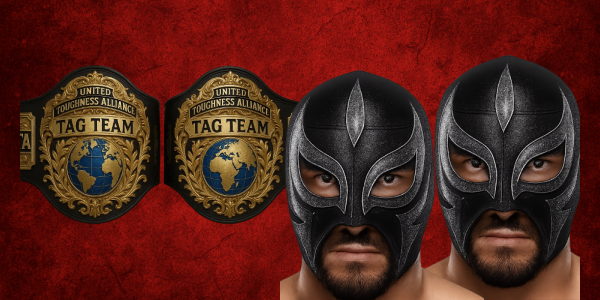
Avril reacting like she’d been touched by something she didn’t want to name. A voice saying, “We’re here.” Masked figures at ringside like an omen. A moonsault that wiped out both Fatus at once, as if the night itself had recruited its own soldiers.


UTA has seen mysteries before. It has seen factions rise and fall, conspiracies burn bright and collapse.


But this felt different.


This felt like Gunnar’s story wasn’t just about Gunnar anymore.


And that is where The Spotlight turns cruel—because the truth is Gunnar Van Patton has not chased a championship yet the way most men would. He has chased control. He has chased clarity. He has chased the kind of fight that makes a man feel something again.


But the UTA is full of people who believe control is theirs by right.


Scott Stevens believed it.
Iron Dominion believed it.
The Fatus enforced it.


Now the question is simple, and it’s the kind of question UTA hates because it can’t be answered with a booking sheet:


If Gunnar Van Patton is the storm…


Who, exactly, is the lightning?


And what happens when it finally hits?


Because if the past months have proven anything, it’s this:


Gunnar didn’t arrive to be part of UTA’s story.


He arrived to test whether UTA deserves to keep telling stories at all.


LISTEN TO THE SPOTLIGHT PODCAST EPISODE FOR GUNNAR VAN PATTON ON SPOTIFY.


← Back to The Spotlight