
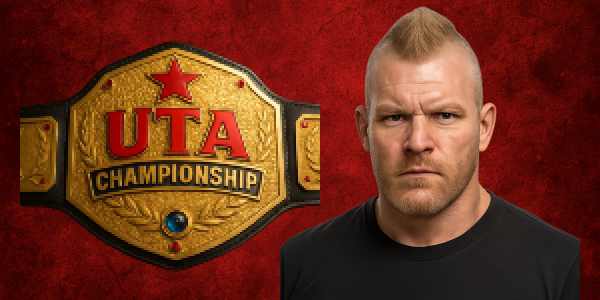

Trey Mack - Built to Collide
Posted on March 12, 2026 by WrestleUTA.comThere are some wrestlers who need time to introduce themselves.
Trey Mack did not.
From the moment he arrived in UTA, Trey Mack made it clear he was not here to slowly find his footing, shake hands, and wait his turn. He came in loud, confident, and completely unafraid of the spotlight. More impor...
Jaxson Ryder: The Hometown Hero. The Ace. The Backbone of U.S.A.
Posted on March 3, 2026 by WrestleUTA.comRoots in Dayton
Before the lights.Before the chants.Before the red, white, and blue strobes.
There was Dayton, Ohio.
Jackson Davis grew up in a city built on grit. Factories. Friday night football. Hard work that didn’t always come with applause. His father was a machinist. His mother worke...
Emily Hightower - A Dog Still Runs This Yard
Posted on February 24, 2026 by WrestleUTA.comThere are wrestlers who are born into legacy, and there are wrestlers who inherit it like a burden. Emily Hightower did neither.
She grew up in it.
The scrap yards. The rusted steel. The hard edges of a world where you don’t get applause for surviving — you just survive. The daughter o...
CHRIS ROSS — THE MAN WHO WALKED THROUGH FIRE
Posted on February 18, 2026 by WrestleUTA.comThere are champions… and then there are survivors.
Chris Ross was never supposed to be either.
He did not arrive in the United Toughness Alliance wrapped in destiny or polished in promise. He came out of Harrisburg — out of concrete, smoke, and nights that don’t end clean &mdash...
Magnus Wolfe —The Scarred Alpha Who Refuses to Break
Posted on February 11, 2026 by WrestleUTA.comIn the United Toughness Alliance, there are men who create moments… and there are men who create consequences.
Magnus Wolfe has built his reputation on the latter.
He is not the loudest voice in the room. He is not the flashiest figure beneath the lights. But when Magnus Wolfe moves, someth...
Angela Hall: The Calm Before the Roar — and the Roar That Ends It.
Posted on February 4, 2026 by WrestleUTA.comThere are wrestlers who walk to the ring like they’re arriving.
And then there’s Angela Hall—who shows up the way weather does.
One moment the air is still, the crowd is settling, the night is pretending it can be predicted… and then the tron cracks with blue lightning and...
Brick Bronson
Posted on January 28, 2026 by WrestleUTA.comThere are wrestlers who arrive with fireworks and catchphrases, men who announce themselves like a commercial break you can’t skip.
Brick Bronson arrives like a door that doesn’t open so much as it gives way.
The lights bleed into red, industrial and oppressive, like the building&rsquo...
Susanita Ybanez, the Fire You Don’t Hear Coming
Posted on January 21, 2026 by WrestleUTA.com
The first thing you notice isn’t her size.
It’s the way the room changes when she arrives—when the lights fall into that deep, arterial red and the drums start thudding like a second heartbeat. The violin threads through the noise like a warning siren. And then the fire co...
Maxx Mayhem and the Gospel of Broken Things
Posted on January 13, 2026 by WrestleUTA.comThere are wrestlers who arrive like weather—predictable patterns, seasons you can set a watch to. They warm up the ring with wrist control and footwork, speak in the clean grammar of fundamentals, and leave behind the kind of matches that fit neatly into a file cabinet.
And then there is Maxx...
Jarvis Valentine — The Man Who Treated a Title Reign Like a Promise
Posted on January 7, 2026 by WrestleUTA.comThere are champions who win gold and treat it like a photograph—something to hold up, smile for, then tuck away when the lights move on.
And then there’s Jarvis Valentine: a man who carried his championship the way a journalist carries a notebook—like proof. Like responsibility. L...
 Hall of Fame – March 26, 2026
 No Love Lost – March 7, 2026
 Jackpot – February 27, 2026