

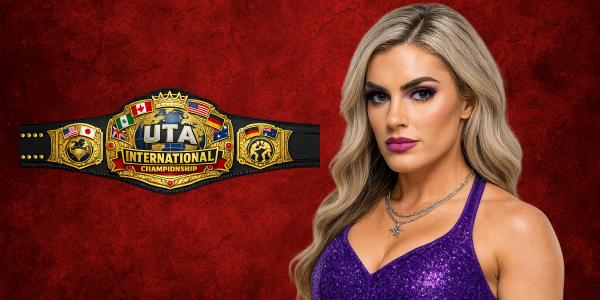
Angela Hall: The Calm Before the Roar — and the Roar That Ends It.

Posted on February 4, 2026 by WrestleUTA.com in The Spotlight


There are wrestlers who walk to the ring like they’re arriving.


And then there’s Angela Hall—who shows up the way weather does.


One moment the air is still, the crowd is settling, the night is pretending it can be predicted… and then the tron cracks with blue lightning and she’s already in motion, already striding with that track-and-field purpose that never truly leaves her. She doesn’t waste steps. She doesn’t borrow confidence from the audience. She doesn’t ask permission to be believed. She hits the ramp like a starting lane and the building reacts like it just felt pressure drop.


Angela Hall’s story, on paper, is clean: medals traded for wrestling titles; sprint-honed explosiveness turned into surprise offense; a wrestler who strikes swiftly and vanishes before opponents can catch their breath. But “clean” isn’t the same as “simple.” In UTA, Hall’s career doesn’t read like a checklist—it reads like a forecast, one that keeps changing in real time, brightening and darkening depending on who’s unlucky enough to be standing across from her when the clouds roll in.


She’s billed from Omaha, Nebraska, but she carries herself like she learned her cadence from thunder. Focused. Relentless. Never letting up. In-ring tactics that blend strikes with high spots, because why choose between impact and flight when you can weaponize both? “Always do: hit aerial moves.” That’s not a preference—it’s a promise.


And every great wrestler has an internal mythology. Hall’s is elemental.


You can see it in the move names alone: Storm Surge Moonsault, Lightning Bolt Lariat, Cyclone DDT, Gale Force Knee, Thunderclap Spear—offense that doesn’t just hurt you, it arrives. Her specials don’t sound like techniques, they sound like conditions: Twister Slam, Eye of the Storm Cutter, Raging Rapids Suplex. The finish is a punctuation mark you feel in your teeth: Hurricane Hammer, a pumphandle slam thrown with authority, the kind that doesn’t simply end a match so much as erase the moment before it.


But it’s the setup that’s most revealing.


A double powerbomb. Not one. Two stacked into a third like a countdown. A daze ritual. A storm siren. It’s Hall saying, I’m not guessing anymore. I’m deciding.


In the ring, she’s a sprinter who learned how to fight in long distances. That’s her secret: she can end you quickly, but she’s also willing to stay in the storm until somebody breaks.


We’ve seen her live in that brutal middle stretch where the crowd stops being entertained and starts being nervous. There’s a particular moment—one of those sequences that becomes a shorthand for a wrestler’s identity—where Hall goes into that second wind and the match changes temperature. The commentary calls it what it looks like: a cyclone taking form.


Powerbomb. Powerbomb. Powerbomb.


Then Hall rises, burns the air with a single sentence—“IT ENDS NOW!”—and drops the Hurricane Hammer like the ceiling just came loose.


And still—sometimes—wrestling refuses to cooperate.


Sometimes the shoulder comes up. Sometimes the opponent survives what was supposed to be a final chapter. Sometimes the champion has to learn that dominance isn’t the same thing as inevitability.


That’s the thing about Angela Hall: her highlights are violent, but her legacy is built in the spaces between highlights—the breathless seconds after the move lands, when the referee’s hand hovers, when the crowd is mid-scream, when the future is balanced on a fingertip.


She’s had gold. She’s lost gold. And she’s done both with the same expression: the face of someone who understands that championships don’t make you real—pressure does.


Her rise didn’t happen slowly. It happened like a storm front crossing a county line.


She won the Florida State Women’s Championship at IN THE ZONE on June 25, 2025, coming out of a Women’s Battle Royal and turning that moment into a 52-day reign with four defenses before dropping it at The Great Southern Trendkill Tour — Birmingham, Alabama on August 15, 2025.


And then, on that same date—August 15, 2025—she leveled up again: capturing the UTA Women’s United States Championship, the kind of title that doesn’t just sit on your waist, but announces you as a standard the division has to measure itself against. Hall held it for 45 days, defended it four times, and carried it like it belonged there.


When a wrestler’s momentum is that sharp, the world starts reorganizing itself around them. The camera finds them first. The storylines tilt toward them. The building starts expecting lightning.


That’s why the losses matter. Not because they diminish her, but because they prove she’s human enough to be hurt.


When Emily Hightower took the Women’s United States Championship from her at The Great Southern Trendkill on September 28, 2025, it wasn’t just the end of a reign—it was the end of an assumption. That assumption being: Hall was going to sprint through the division forever without tripping.


UTA has a habit of forcing its brightest stars to learn the same lesson: the higher you climb, the more the fall has room to mean something.


And if you want to understand Angela Hall, you don’t start with her wins. You start with her willingness to keep charging anyway.


There’s an image that encapsulates her championship era: Hall arriving with the U.S. title slung over her shoulder, leather jacket over her gear, stepping out with the calm confidence of someone who knows the arena will meet her where she lives. The division framed her as its standard-bearer—dominant, rising, the kind of champion the company can build around.


But wrestling is never content to let anyone be only that.


Because the storm has enemies. The storm creates enemies.


And sooner or later, someone figures out where the wind comes from.


At Survivor 2025, Angela Hall didn’t just walk into a match—she walked into a war. Team MVC versus The Empire isn’t the kind of story you “participate” in; it’s the kind you survive or you don’t. And in the cruel math of elimination wrestling, the first person out isn’t just eliminated—they’re removed from the future for long enough to feel what that absence costs.


Hall was that person.


Not because she lacked heart. Sometimes the body taps before the heart does. Dahlia Cross targeted the shoulder until the pain made the decision that pride refused to make. And when Hall’s hand hit the mat—three times, rapid and desperate—the shock in the arena wasn’t just about the elimination. It was about what it symbolized: The Empire didn’t just score a point; they took away one of Team MVC’s biggest weapons early, and they did it by cutting the storm down at the root.


That’s the part that sticks to you when you’re watching.


Angela Hall, clutching the limb, being checked by officials, surrounded by teammates—Marie Van Claudio kneeling beside her, Emily Hightower pacing like a caged animal, Valkyrie Knox furious enough to vibrate. You can almost feel the helplessness in it: the storm isn’t supposed to limp.


But here’s what a lot of people miss about Hall: her identity is not “invincible.”


Her identity is inevitable motion.


You don’t need allies listed on a roster sheet for that. You don’t need rivals assigned by the database for that. The rivalry is built into her style: Hall versus hesitation. Hall versus anyone trying to slow the pace. Hall versus a division that keeps learning how to build walls in front of sprinters.


Even her quote reads like a mission statement, the kind of line you don’t say unless you’ve had to live it:


“I am the calm before the storm—and the storm itself.”


That’s not bravado. That’s control. That’s a wrestler telling you she can wrestle the match and end the match—she can pace it, and she can detonate it.


And that duality is why her accolades don’t feel like awards on a shelf—they feel like timestamps on a career that keeps accelerating. Superstar of the Month in August 2025. Superstar of the Week twice in the same month. Recognition that didn’t arrive as a favor, but as an acknowledgment that, for stretches of time, Angela Hall was the most unavoidable presence in the women’s division.


There’s also the little myth pinned at the bottom of her file like a warning label:


Hall once hit a moonsault off a 15-foot scaffold.


That single sentence does an enormous amount of work. It tells you she’s fearless in the way people aren’t supposed to be. It tells you she understands spectacle as a weapon. It tells you she’s willing to break the rules of safe gravity to win. And it tells you something else, too, if you’re honest about it: she is the kind of wrestler who will always be tempted to become weather in the most literal sense—to fly higher, hit harder, leave nothing behind but aftermath.


So what is Angela Hall now, in the wake of titles won and titles lost, in the wake of Survivor scars and Empire tactics?


She’s still the same thing she was when she first traded lanes for ropes: a competitor whose first language is acceleration.


But she’s also a little more dangerous than she used to be, because she’s been reminded that storms don’t just happen. Storms are shaped. Redirected. Exploited. And if your whole world is built around speed, the first person who learns how to attack the wheels is going to change your life.


Dahlia Cross did. Emily Hightower did. The division has.


And now the question isn’t whether Angela Hall can erupt. We know she can. We’ve seen the Thunderclap Spear carve people in half, the Raging Rapids Suplex fling bodies like debris, the Hurricane Hammer drop like the sky falling.


The question is whether she can adapt without losing herself.


Whether she can be the calm before the storm when the storm isn’t arriving on her schedule.


Whether she can stay relentless while learning to protect what opponents have learned to target.


Because the most poetic truth about Angela Hall is also the harshest:


Weather doesn’t retire. It only changes patterns.


And in UTA, sooner or later, every wrestler finds out what kind of storm they really are—when the sky doesn’t cooperate, when the ground won’t forgive, when the title isn’t around their waist, and the only thing left is that moment on the ramp, blue lightning on the tron, the building holding its breath…


…waiting to see if the storm is still coming.


Angela Hall always does.


← Back to The Spotlight